Culinary Tourism: Where Luxury Meets Local
What's New
What you eat, and where you eat it, can reveal the true character of your destination. Prioritise local flavours and history will reveal itself with every bite, promising authentic experiences and a true sense of place. We asked travel writer and culinary travel enthusiast Larry Olmsted to inspire your next journey with his pick of dishes that should be tasted on location, from Germany to Thailand.
Travelling to taste at the source
The explosion of Mount Vesuvius was devastating, but the rich volcanic soil left behind now produces the world’s finest tomatoes, Italy’s prized San Marzanos. The most coveted beef calls Japan’s Kobe home, Madagascar is famed for its vanilla beans, and chefs worldwide seek out Maine lobsters. But while terroir-based ingredients can be exported, it’s trickier with recipes for regional specialities, reliant on traditional ingredients and preparations, often left behind when national cuisines go worldwide. Despite globalisation, there are still many dishes done best in the places where they were invented, and this is the essence of culinary tourism.
Visiting food markets is a great way to uncover the secrets of your destination.
HAIRY CRAB: SHANGHAI, CHINA
There are many hyper-local dishes worth seeking out when you travel, and gourmet visitors to Shanghai in the autumn always make a beeline for restaurants serving the legendary local freshwater crustacean, Hairy Crab, or Chinese Mitten Crab. These aromatic seasonal crabs are best between September and December, have a strong umami flavour with a slightly salty brininess, and buttery meat with a fluffier mouthfeel than most crabs, filling restaurants with fragrance during cooking. They are so prized that they often come to the table accompanied by serial number tags proving their provenance, and while there are creative presentations, the classic preparation is to steam the crabs whole, then dip the meat in black vinegar with ginger.
Travel tip? Journey to Shanghai to get an authentic taste of this Chinese delicacy and stay riverside at Grand Kempinski Hotel Shanghai.
RACLETTE: SWITZERLAND
In the Swiss Alps, many traditional dishes involve melted cheese, but the humblest and most satisfying is raclette. Unlike its siblings, it requires no special pot, cooker or added liquids, just a heat source (originally a shepherd’s campfire, as the dish dates back at least 400 years).
Raclette, from the French racler, 'to scrape', is also the name of its key ingredient, a semi-hard Alpine cheese made from raw cow’s milk in a border region of France and Switzerland, with protected designation of origin (PDO) status in both. A cut wheel is exposed to fire or, in restaurants, a heat lamp, until the surface liquifies. This is scraped with special wooden paddles and spread on an array of potatoes, pickled vegetables and cured meats. It’s a social experience, and the selection of foods makes for a varied and richly delicious meal.
Travel tip? Locals will tell you that raclette can be enjoyed at any time of the year. Whether surrounded by snow or basking in the summer sun, Kempinski Palace Engelberg and Grand Hotel des Bains Kempinski St. Moritz are the perfect base to relax after a hearty cheese feast.


TOM YUM: THAILAND
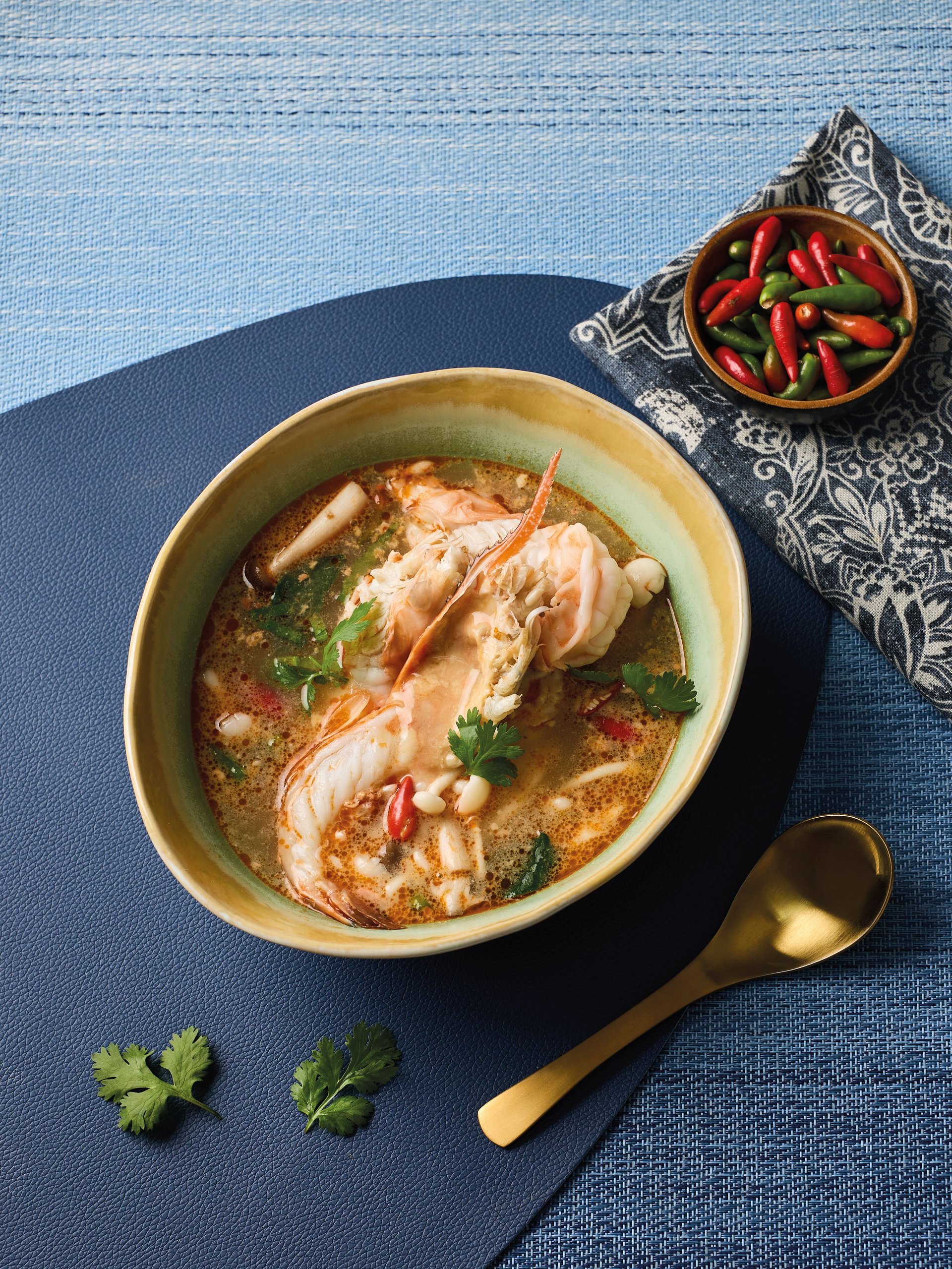
Thailand is a radically diverse country stretching from the Himalayas to sub-tropical islands, with plains, forests, and river basins, and its cuisines are equally diverse. But one constant almost anywhere you go is tom yum (or yam), a soup so central to Thai identity that in 2021, the government applied to have it recognised by the United Nations as part of its cultural heritage.
It’s a dish where every household has its own recipe, and there is no one style, with both creamy (tom yam nam khon) and clear (tom yam nam sai) varieties, using broth or coconut milk, but the common thread is a strong, hot and sour contrast. Deep flavour and spice come from shrimp shells and long-simmered, pounded fragrant ingredients, including lemongrass, kaffir lime leaves, chilis, and ginger. Tom yum is typically topped with chopped fresh coriander and served with white rice, and you can keep trying it as you travel, with greatly differing experiences.
Travel tip? Sample tom yum soup in Siam Kempinski Hotel Bangkok as part of a five-course Thai degustation menu at award-winning Sra Bua by Kiin Kiin. Over at Flourish restaurant in Sindhorn Kempinski Hotel Bangkok, authentic Thai flavours are reimagined with Levantine influences.
SHAWARMA: TÜRKIYE AND THE MIDDLE EAST
Another diverse and varied local favourite is shawarma, a Middle Eastern signature dish dating to the Ottoman Empire. Both a sit-down meal and beloved street food, it is the method of cooking, not the protein, that makes this dish. Sliced raw meat flavoured with Middle Eastern spices such as cumin, cardamom and paprika is stacked and formed into a large, inverted cone that is slow roasted on a vertical spit (the name derives from Ottoman Turkish for 'revolve' or 'rotisserie'), constantly sliced from the outer edge as it cooks, creating a mix of crispy and succulent meat.
It originated in Türkiye with lamb but can be beef or poultry, and was even exported to Mexico by Lebanese immigrants, becoming tacos al pastor. Shawarma is served as a sandwich on pittas or thinner flatbreads, usually with tahini or toum, an Arabic garlic sauce. In the Middle East, it is more meat-centric, with simple chopped onions, parsley and sometimes turnips, while Türkiye, where it has become doner kebab, adds lettuce and tomatoes.
Travel tip? Make sure you see both sides of the shawarma. Dine and sleep like an Ottoman Sultan in its birthplace, at Çırağan Palace Kempinski Istanbul, or follow its evolution to get a taste in Lebanon, staying at Kempinski Summerland Hotel & Resort.


WEISSWURST: MUNICH, GERMANY
Over in Germany, it's said that there are some 1,500 kinds of sausages, or wursts, but one of the most important – and least understood – is Weisswurst, a Bavarian speciality found around Munich.
Named for its white colour, it is made from veal, with added pork fat, chopped onions, parsley and a light touch of spices, including mace, nutmeg and cardamom. For Oktoberfest visitors, it is a staple of morning-after recovery from overindulgence, as Weisswurst's most unique attribute is its popularity as a breakfast meat. Just as Italians raise an eyebrow at foreigners ordering cappuccino after 11:00, Weisswurst is traditionally enjoyed before noon, as it is neither smoked nor preserved and has a short shelf life. Sausages are simmered – never boiled, as they would split – and often come in a bowl of water to keep them warm, although it is not soup. You peel the casing off and eat only the insides, like a banana, accompanied by pretzel and mustard, and it is considered bad luck to eat an even number of links.
Travel tip? For full cultural immersion, visit Munich to experience Oktoberfest, followed by Weisswurst for breakfast. Stay central at Hotel Vierjahreszeiten Kempinski, or escape the crowds and experience regal living at Kempinski Royal Residence Nymphenburg.
These dishes are all very different, but what they have in common is that they were created to make use of the best local ingredients, and that is what still makes them so special centuries later.
If you enjoyed this exploration of local dishes, why not sample other unique dining experiences?
or to enjoy up to 10% off your next stay.